
Companies featured here may provide compensation for click throughs. This is how I maintain free research for consumers. My full disclosure of who I invested with is on this page for transparency.
I bought my first gold coins in 2007 — about eight months before Bear Stearns collapsed and the world discovered that financial systems built entirely on paper are more fragile than anyone in a bull market wants to believe. Gold was trading at around $650 per ounce. As I write this in 2026, it has cleared $4,300.
I’m not sharing that to make a prediction. I’m sharing it because the question of how to buy gold in an IRA is one I’ve answered from lived experience, not theoretical research — and the answers I’ve gathered while owning precious metals inside tax-advantaged retirement accounts are meaningfully different from the ones you’ll find in articles written by people who’ve never actually done it.
This guide covers everything: what a gold IRA actually is, why the advantages are as significant as they appear, the IRS rules you cannot afford to get wrong, every step of the purchasing process from account opening to metals in storage, and the specific details — dealer markups, buyback spreads, the home storage trap — that most articles leave out because they’re inconvenient to discuss.
By the end of this guide, you’ll know exactly how to buy gold in an IRA, what it costs, what it protects against, and how to avoid the pitfalls that have cost real investors real money.
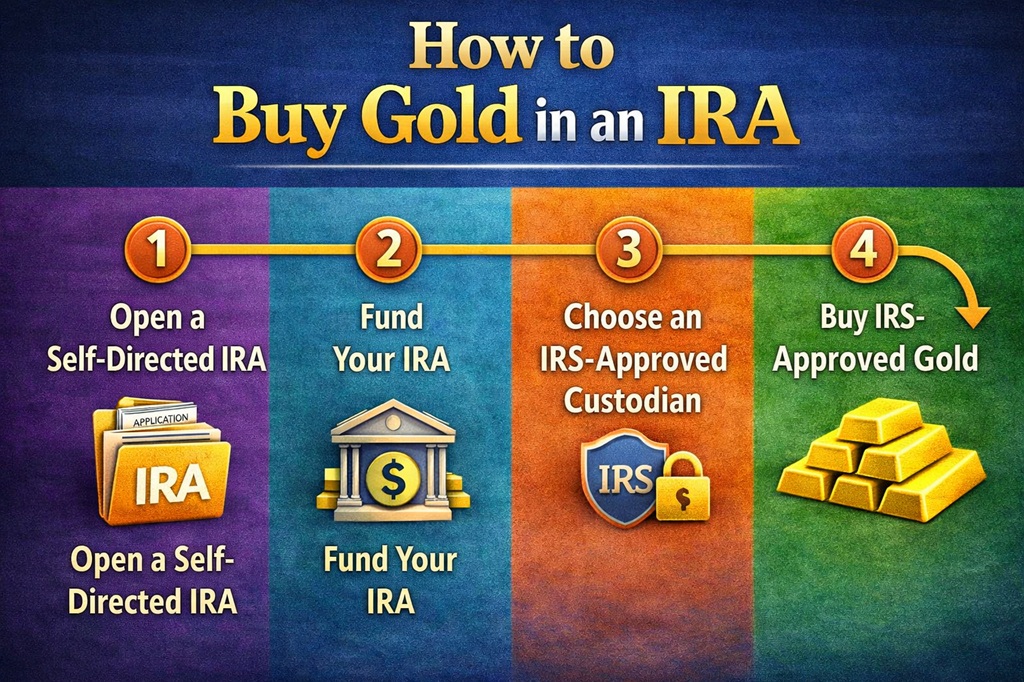
What Is a Gold IRA?
A Gold IRA is a type of specialized individual retirement account that enables investors to hold physical gold and other precious metals while benefiting from tax advantages. Unlike regular IRAs that focus on paper assets like stocks and mutual funds, Gold IRAs enable you to invest in tangible physical metals such as gold bullion and coins.
More specifically: a gold IRA is a self-directed IRA (SDIRA). The self-directed designation means you — not a brokerage’s product menu — control which specific, IRS-approved assets are held in the account. Investing in precious metals through a self-directed IRA offers diversification beyond traditional assets, serving as a hedge against inflation and economic downturns. These tangible assets can provide stability and potential growth for your retirement savings.
The account can hold physical gold, silver, platinum, and palladium — provided those metals meet specific IRS purity standards. Growth is tax-deferred in a Traditional gold IRA, or permanently tax-free in a Roth gold IRA. The metals are stored not at your home, but at an IRS-approved depository under the oversight of an independent custodian.
Gold IRAs are governed by federal tax law, specifically Internal Revenue Code Section 408(m). This section outlines which types of precious metals are allowed in retirement accounts and which are classified as prohibited “collectibles.” As a result, only certain forms of gold can legally be purchased within an IRA.
Understanding that statutory framework before you purchase anything is the single most important step in this entire process.
Why Buy Gold in an IRA? The Advantages That Make This Investment Compelling
Before I walk through the mechanics of how to buy gold in an IRA, I want to address the more important question: why would a serious investor choose to do this at all? After 19 years of holding precious metals inside retirement accounts, here is my honest, evidence-grounded answer.
Gold Is the Most Proven Inflation Hedge in Investment History
Physical gold is one of the few assets that cannot be hacked, erased, liquidated by a failing corporation, or inflated artificially. The dollar has lost more than 96% of its purchasing power since 1913. Gold, over the same period, has dramatically increased its purchasing power in real terms.
For a retirement investor whose account may sit largely untouched for 15–25 years before full distribution, the slow, silent erosion of dollar purchasing power is not an abstract risk — it is a concrete, compounding threat to the real value of savings built over an entire working career.
Gold Moves Independently of Stocks and Bonds
One of the biggest advantages of a Gold IRA is protection from inflation. As the cost of living rises, the purchasing power of the dollar decreases — but historically, gold often moves in the opposite direction.
In 2022, both U.S. equities and bonds posted their worst simultaneous performance in decades. The 60/40 portfolio — the standard retirement allocation of 60% stocks, 40% bonds — lost ground as the Federal Reserve tightened aggressively. Gold gained approximately 0.3% that year. In 2020, when the S&P 500 fell 34% in roughly five weeks, gold gained 25%. The non-correlation is not theoretical. It is the most historically consistent and most financially significant property that gold brings to a retirement portfolio.
The 28% Collectibles Tax Rate Is Eliminated Inside an IRA
This is the tax advantage that most “how to buy gold in an IRA” guides either skip or mention in one sentence. It deserves more than that.
Physical gold held outside of an IRA — in a taxable brokerage account or at home — is classified by the IRS as a “collectible.” Long-term capital gains on collectibles are taxed at a maximum rate of 28%. This is significantly higher than the 15%–20% rate applied to most long-term equity gains. A gold investor who holds $200,000 in physical gold outside an IRA and sells at a $100,000 gain faces a potential $28,000 tax bill.
Inside a gold IRA, that 28% rate never applies. In a Traditional gold IRA, gains are tax-deferred. In a Roth gold IRA, gains are permanently tax-free at distribution. The difference on a large, long-held gold position can be tens of thousands of dollars that stay in your account rather than going to the IRS.
Gold Has Generated Exceptional Returns in the Modern Era
In 2024, gold offered a 27% annual return, outperforming the S&P 500 by 2%. The average gold IRA investment reported by major providers rose from $35,000 in 2023 to $100,000 in 2024.
Gold prices spiked to new records in 2025, up 44% annually, outpacing the S&P 500. Analysts project continued strength driven by tariffs, inflation, and trade war fears.
I want to be honest about what this means and doesn’t mean. Gold’s primary function in a retirement portfolio is protection and preservation, not growth. But when inflation is elevated, the dollar is weakening, and geopolitical instability is driving safe-haven demand, gold can and does generate equity-level returns. We have been in exactly that environment since 2022. Investors who completed gold IRA rollovers in 2022 and 2023 have watched their precious metals allocations outperform the equity portion of their retirement portfolios over that period by a meaningful margin.
Tangible Ownership — Real Property, Not a Counterparty Promise
A key selling point of these investment products is that you own the physical gold itself. When I took my first in-kind distribution from my precious metals IRA — actual gold coins delivered to my home rather than a cash deposit — the experience was qualitatively different from any other retirement account distribution I’d ever received. I held something real, something that had retained value across five millennia of human economic history, something whose value depends on no company’s earnings, no government’s creditworthiness, and no financial infrastructure remaining functional.
That tangibility has practical value that paper assets cannot replicate in a systemic financial crisis — which is, by definition, the moment when retirement protection matters most.
IRS Rules for Buying Gold in an IRA: What You Must Know Before You Purchase Anything
It’s important to understand the difference between owning gold personally and owning gold inside an IRA. You can personally buy almost any type of gold — jewelry, rare coins, collectibles, etc. Inside an IRA, you can only hold gold that meets specific IRS criteria. The same metal can be perfectly fine for personal investment yet completely ineligible for an IRA.
IRS Purity Requirements for Gold and Other Precious Metals
The IRS mandates specific purity standards to ensure you are holding investment-grade bullion, not collectibles.
| Metal | Minimum Purity | Key Approved Products |
|---|---|---|
| Gold | 99.5% (0.995) | American Gold Buffalo, Canadian Maple Leaf, Austrian Philharmonic, Australian Kangaroo/Nugget |
| Silver | 99.9% (0.999) | American Silver Eagle, Canadian Silver Maple Leaf, Austrian Silver Philharmonic |
| Platinum | 99.95% (0.9995) | American Platinum Eagle, Canadian Platinum Maple Leaf |
| Palladium | 99.95% (0.9995) | Canadian Palladium Maple Leaf, Russian Ballerina |
The American Gold Eagle Exception: The most popular IRA gold coin — the American Gold Eagle — is actually only 91.67% pure gold. It qualifies for IRA ownership through a specific statutory exemption granted because it is produced by the U.S. Mint under federal law. It is the only IRA-eligible gold coin that doesn’t meet the standard 99.5% purity threshold.
Purity alone is not enough. The IRS also requires that IRA eligible gold must be produced by an approved and accredited source — government mints such as the U.S. Mint or Royal Canadian Mint, or accredited refiners meeting COMEX or NYMEX standards. Gold bars or coins from unknown, private, or uncertified sources are typically not eligible.
What Is Never IRA-Eligible
Just make sure they meet IRS standards, or otherwise, they count as “collectibles,” which are prohibited by the IRS. In this case, purchasing these items would count as distributions — meaning they could come with a 10% penalty if you’re under age 59.5.
Specifically, the following are never IRA-eligible regardless of metal content: jewelry, numismatic or collectible coins graded by PCGS or NGC, privately minted rounds from unaccredited sources, damaged or altered bullion, and gold certificates or ETFs (these are paper instruments, not physical metals).
If you purchase non-eligible gold inside an IRA — either intentionally or by accident — the IRS can treat it as a prohibited transaction. Understanding eligibility rules upfront helps you avoid these costly mistakes.
The Home Storage Prohibition — No Exceptions, No Workarounds
This is the rule most frequently misrepresented in the gold IRA marketing ecosystem, and the one with the most severe consequences for investors who violate it.
The federal courts reinforced this in the 2021 case McNulty v. Commissioner. The Tax Court ruled that IRA-owned metals stored personally were treated as distributed, which triggered income tax, penalties, and account disqualification. The rule is simple: personal possession equals a taxable distribution. There are no exceptions in 2026.
In compliance with IRS rules, precious metals owned in an IRA may not be held by the IRA owner. They must be stored at an IRS-approved depository under the custody of your account’s trustee.
Attempting to store IRA metals at home — in a personal safe, a bank safe deposit box, or under any legal structure that a gold IRA company might market as a “home storage” arrangement — constitutes a prohibited transaction. The consequence is immediate account disqualification: the entire balance becomes taxable income in the year of the violation, plus a 10% early withdrawal penalty if you’re under 59½.
There is no compliant home storage gold IRA. Any company marketing one is selling a product the IRS does not recognize.
IRS-Approved Depositories for Gold IRA Storage
Depositories are responsible for conducting annual audits, incorporating quality control methods, carrying insurance, and conducting authentication testing.
The most widely used IRS-approved depositories are:
- Delaware Depository (Wilmington, Delaware) — the industry gold standard; carries $1 billion in all-risk insurance
- Brink’s Global Services — multiple U.S. locations; Class 3 vaults
- International Depository Services (IDS) — Texas and Delaware locations
- Texas Precious Metals Depository — Shiner, Texas; exclusively Texas-based
- CNT Depository — Bridgewater, Massachusetts
Storage is available in two forms: segregated storage, where your specific metals are held in a separate, labeled compartment exclusively in your name; and commingled storage, where your metals are pooled with other investors’ holdings of the same type. I consistently recommend segregated storage. The additional cost — typically $50 per year — is worth the precise audit trail and the knowledge that the specific metals you deposited are the specific metals that will be returned to you at distribution.
How to Buy Gold in an IRA: The Complete Step-by-Step Process
When I executed my first gold IRA purchase in 2007, the process was more complex than it needed to be because I was navigating it largely without guidance. Today, reputable gold IRA companies handle the vast majority of the process on your behalf. Here is exactly what happens, step by step.
Step 1: Choose a Reputable Gold IRA Company

Reputable companies focus on educating investors rather than rushing them into purchasing metals.
This is the most consequential decision in the entire process, and the one most investors rush. Your gold IRA company is your guide, your dealer, and your relationship manager for potentially the next 15–20 years. Choose based on: BBB rating (A+ is the floor), years in operation, verified reviews across multiple independent platforms, fee transparency before any commitment, and the nature of the sales culture — education-first or commission-driven.
The three companies I recommend most consistently based on verified track record:
- Augusta Precious Metals — for investors with $50,000 or more. Zero BBB complaints since 2012. Harvard-trained economist leads mandatory one-on-one educational web conferences. Salary-based specialists, no commission. Money magazine “Best Overall” four consecutive years.
- Goldco — for investors with $25,000 or more. $3.5 billion in metals placed. 8,000+ five-star reviews. Guaranteed highest-price buyback.
- Noble Gold Investments — for investors starting at $10,000–$20,000. A+ BBB rating. Exclusive Texas storage option. Universal segregated storage policy.
Step 2: Open a Self-Directed IRA With an IRS-Approved Custodian
Traditional brokerage firms limit accounts to the financial products they administer. They do not custody precious metals. A Self-Directed IRA removes that barrier.
Your gold IRA company will coordinate this with their preferred custodian — Equity Trust Company, Entrust Group, and STRATA Trust are the most commonly used. The application takes approximately 15 minutes and typically results in account establishment within 1–3 business days. Your company handles the paperwork coordination; your primary role is reviewing and signing documents.
IRA types available include: Traditional Gold IRA (funded with pre-tax dollars; growth is tax-deferred; distributions taxed as ordinary income); Roth Gold IRA (funded with after-tax dollars; growth and qualified distributions are completely tax-free); SEP Gold IRA (designed for self-employed individuals and small business owners; allows much higher contribution limits).
Step 3: Fund Your Gold IRA
You can fund your account via direct contributions, transfers, or rollovers from plans like a 401(k).
Option A: Direct Contribution. For 2026, the IRA contribution limit is $7,500 ($8,600 if age 50 or older). These limits apply across all IRAs you own combined — not per account. Contributions must come from earned income (wages, salaries, or self-employment income).
Option B: Direct Transfer (IRA to Gold IRA). Moving funds from an existing Traditional or Roth IRA to your new gold IRA via a direct, trustee-to-trustee transfer. No taxes, no withholding, no 60-day deadline, and no one-rollover-per-year limitation. This is the simplest, safest, and most common funding method.
Option C: Rollover From a 401(k), 403(b), TSP, or Other Qualified Plan. You can fund your self-directed IRA with a transfer from another qualifying retirement plan. Eligible accounts include 401(k), 403(b), 457(b), Thrift Savings Plan, SEP IRA, and SIMPLE IRA. Always use a direct rollover — where funds move custodian-to-custodian without passing through your hands. An indirect rollover requires you to deposit the full pre-distribution amount within 60 days, and your plan administrator is required to withhold 20% for federal taxes in the interim. The math frequently disadvantages investors who don’t understand this before initiating.
Critical note on rollover amounts: For 2026, the contribution limits for Gold IRAs are set at $7,500. Rollover amounts do not count toward annual contribution limits. You can roll over a $500,000 retirement account and still make your full annual contribution to the same gold IRA in the same tax year.
Step 4: Select Your IRS-Approved Precious Metals
Once your account is funded, work with your gold IRA specialist to select specific metals. This is where investor preparation pays the most significant dividends.
My consistent recommendation for every investor: focus on standard, widely-traded, government-minted bullion. American Gold Eagles, American Gold Buffalos, Canadian Gold Maple Leafs, American Silver Eagles. These products carry the tightest dealer markups, the strongest secondary market liquidity, and the clearest IRS approval status. They are the metals that generate the smallest spread between what you pay to buy and what you receive when you sell.
The premium coin question — addressed directly:
The most costly mistake I see gold IRA investors make is purchasing “exclusive,” “limited-edition,” or “semi-numismatic” coins promoted by dealers without understanding the economics. These products can carry dealer markups of 30%–150% above spot price. An investor who places $50,000 into coins carrying a 75% markup has effectively paid $21,000 above the real market value of the metal content. When they try to sell, no dealer will offer a 75% premium — they’ll receive a standard buyback spread of 3%–8% above spot. The account may show a value far below the purchase price from the first account statement.
The question every investor must ask before any purchase: “What is the exact premium above current spot price on this product? And what is your simultaneous buyback quote today?” Request both in writing. The gap between those two numbers is the real economic cost of the product you’re being shown. A reputable company will answer both questions immediately and in writing. If they don’t, you have all the information you need about whether to proceed.
Step 5: Direct Your Custodian to Complete the Purchase
After you’ve picked which approved metals you want to buy, you can direct your custodian to purchase them on your behalf. They’ll then need to store the gold in an IRS-approved depository for safekeeping. You’re not allowed to purchase the metals yourself or store them at home.
You submit a purchase direction to your custodian specifying the metals, quantity, dealer, and depository. The custodian coordinates the transaction — funds are released to the dealer, and metals are shipped directly to the depository. You receive a purchase confirmation and a depository receipt confirming that your specific metals are in storage.
Step 6: Confirm Storage and Establish Your Account Management Process
Once metals are in storage, you receive confirmation documentation identifying your specific holdings — coin type, weight, purity, quantity, and assigned vault location. Annual account statements reflect both the quantity of metals held and their current market valuation based on spot price.
Annual fair market valuations of your metals are required for accurate IRS reporting. Investing.com Your custodian provides this valuation annually, which is also the figure used to calculate Required Minimum Distributions when they begin at age 73.
Gold IRA Contribution Limits for 2026
Self-directed individual retirement accounts, including gold IRAs, have the same contribution limits and age-based distribution limits as conventional IRAs. For 2026, the IRA contribution limit is $7,500 ($8,600 if age 50 or older).
These limits apply across all IRAs you own collectively in a given tax year. You cannot contribute $7,500 to a Traditional IRA and another $7,500 to a gold IRA in the same year. The total across all accounts is $7,500 (or $8,600 with the catch-up contribution).
For self-employed investors, a SEP Gold IRA allows dramatically higher contributions: SEP IRA contributions are limited to the lesser of 25% of compensation or $72,000 for 2026. For a self-employed investor with significant income, this makes the SEP Gold IRA one of the most powerful retirement accumulation vehicles available.
Gold IRA Withdrawal Rules and Distributions
Before Age 59½: Early Withdrawal Penalties
If you withdraw gold from your IRA before you reach the age of 59.5, you will be assessed income tax on the value of that gold as well as a 10% penalty for taking an early withdrawal from a retirement account.
The tax is assessed on the fair market value of the metals distributed on the date of distribution — not your original purchase price. Limited exceptions to the 10% penalty exist (first-time home purchase, disability, substantially equal periodic payments) but apply narrowly.
At Age 59½ and Beyond: Penalty-Free Distributions
At 59½, the 10% penalty disappears. Traditional gold IRA distributions continue to be taxed as ordinary income. You may take distributions in two ways:
Cash distributions: Your custodian sells your metals at current market prices and deposits the proceeds in your account. This is the most common approach.
In-kind distributions: Your specific metals are shipped directly to you from the depository. Distributions can be in cash (from selling metals) or in-kind (physical metals). Investing.com In-kind distributions are taxed based on the fair market value of the metals on the date of distribution, and you then own the metals outright — outside of any IRA structure — with a new cost basis equal to that distribution value.
Required Minimum Distributions (RMDs) at Age 73
If you opt for a traditional gold IRA, like a traditional IRA, you will have to begin taking RMDs at the age of 73. Failing to take RMDs results in a 25% excise tax on the amount that should have been distributed.
Roth gold IRAs have no RMD requirement during the account holder’s lifetime — a significant advantage for investors who do not need the income and want to maximize the tax-free growth period.
A strategy I’ve used personally: if you hold both a traditional gold IRA and other traditional IRAs (stocks, bonds), satisfy your RMD requirement from the liquid accounts first and leave the precious metals position undisturbed as long as possible. The metals don’t need to be the ones liquidated to meet RMD obligations.
Gold IRA Costs and Fees: What You’ll Actually Pay
Typical fees include setup ($50–$100), annual admin ($80–$160), storage ($100–$150).
Here is a complete, honest breakdown of every cost involved:
One-Time Setup Costs
- Account setup fee: $50–$100 (some companies waive this)
- Wire transfer fee: $25–$30
- First-year total: approximately $275–$330 before any promotions
Annual Recurring Fees
- Custodian/administration fee: $80–$160 per year
- Storage fee (commingled): $100 per year
- Storage fee (segregated): $100–$150 per year
- Total annual: approximately $200–$280 per year
First-Year and Multi-Year Fee Waivers
Several top-tier companies offer significant fee waivers for qualifying accounts:
- Augusta Precious Metals: up to 10 years of fee waivers for qualifying accounts
- American Hartford Gold: first year free at $50,000+; three years free at $100,000+
- Goldco: first year free at $25,000+
- Birch Gold Group: first year free at $50,000+
The Flat Fee Advantage at Scale
The annual flat fee — typically $225–$275 — does not increase as your account grows. At $25,000, it represents approximately 0.9% annually. At $100,000, it’s 0.23%. At $250,000, it’s under 0.1%. For investors with substantial accounts, the flat-fee structure of a gold IRA becomes dramatically more cost-effective than the percentage-based fee structures common in conventional investment accounts.
Gold IRA vs. Gold ETF: A Distinction That Matters Critically
If this doesn’t matter to you, there are other ways to add exposure to precious metals in a retirement account, such as buying stock in gold mining companies or shares of the best gold ETFs.
I’ll be direct about this distinction because most articles treat it as a footnote: a gold ETF and a gold IRA are not the same investment and they do not provide the same protection.
A gold ETF gives you price exposure to gold. It tracks gold’s market price through paper contracts, futures, or fractional ownership claims. In a normal market environment, this exposure is adequate for speculative or growth-oriented investors. In a genuine systemic financial crisis — bank failures, market closures, counterparty defaults — ETFs face risks that physical gold held in your name at a vault does not: trading halts, custodian failures, price dislocations from the underlying physical metal, and counterparty risk in the derivative contracts underlying the fund.
A gold IRA holds real, physical, assigned bullion in an IRS-approved vault in your name. In a true financial crisis, you own something real that no systemic failure can eliminate. The distinction is exactly what I experienced between 2008 and 2010, watching gold ETFs trade at discounts to spot price while physical metal in storage remained fully valued and fully accessible.
How Much of Your IRA Should You Allocate to Gold?
After 19 years of holding precious metals in retirement accounts and watching countless investors navigate this decision, my recommended allocation range is consistent: 5% to 20% of total retirement assets.
5%–10% is the starting position for investors earlier in the accumulation phase, those with longer time horizons, or those making their first precious metals allocation. The diversification benefit is real and measurable; the constraint on equity-based growth is minimal.
10%–15% is the range I consider optimal for most serious retirement investors. It provides meaningful inflation protection and genuine non-correlation benefit without overconcentrating in a non-income-producing asset.
15%–20% is appropriate for investors closer to or already in retirement, those with concentrated equity positions they want to offset, or those with significant concerns about dollar purchasing power and systemic financial risk over the next decade.
The consistent principle: gold preserves and protects. The remaining 80%–95% of your retirement assets continues growing in equities, bonds, and other positions. Gold anchors the portfolio during periods when conventional assets are most vulnerable.
Common Mistakes to Avoid When Buying Gold in an IRA
Purchasing non-IRS-approved metals. A single ineligible coin inside a gold IRA can trigger a deemed distribution of its full fair market value. Always verify IRS eligibility before purchase.
Attempting home storage. There is no compliant structure. The consequences are full account disqualification and immediate taxation.
Using an indirect rollover when a direct transfer is available. The 60-day deadline and mandatory 20% withholding create unnecessary risk. Always use direct, custodian-to-custodian transfers.
Buying premium or specialty coins without asking for a buyback quote. Every product a representative shows you should come with a concurrent buyback quote. Request it in writing. Standard bullion carries 3%–8% spreads; specialty products may carry 30%–150% markups that are essentially unrecoverable.
Over-allocating. Converting more than 20% of a retirement portfolio to precious metals overconcentrates in a non-income-producing asset. Gold’s role is to protect, not to replace a growth strategy entirely.
Summary: How to Buy Gold in an IRA
After 19 years of personal experience and professional analysis in this market, here is the complete answer to how to buy gold in an IRA — distilled into the most important points:
What it is: A self-directed IRA that holds physical, IRS-approved gold, silver, platinum, and palladium instead of stocks and bonds. Growth is tax-deferred (Traditional) or tax-free (Roth). The 28% collectibles capital gains tax that applies outside an IRA never applies inside one.
Who it’s right for: Retirement investors with $10,000 or more in existing retirement accounts who want genuine portfolio non-correlation, proven inflation protection, and tangible asset ownership within a tax-advantaged structure — as 5%–20% of total retirement assets alongside a broader portfolio.
The IRS rules that matter most: Gold must be 99.5% pure (with the American Gold Eagle as the sole exception). All metals must be stored at an IRS-approved depository — no home storage under any structure or legal argument. Use direct, trustee-to-trustee transfers to avoid the indirect rollover’s tax withholding and 60-day deadline. RMDs begin at 73 for Traditional accounts; Roth accounts have no RMD requirement.
The process: Choose a reputable gold IRA company with an A+ BBB rating and thousands of verified independent reviews. Open a self-directed IRA through their preferred custodian. Fund via direct transfer or rollover. Select standard, liquid government-minted bullion — always with a concurrent buyback quote in hand before purchase. Metals ship directly to an IRS-approved depository. Done.
The costs: $50–$100 one-time setup, $200–$280 annually in flat fees, plus a 3%–8% dealer markup on standard bullion. The flat-fee structure becomes extremely cost-effective at $50,000+ account levels, and multiple top-tier companies offer multi-year fee waivers for qualifying accounts.
The companies I trust and their respective reviews:
Request a free gold IRA kit from the company that matches your investment level. Read it before you speak with any specialist. Then call with your written questions ready — premium above spot, simultaneous buyback quote, custodian fee in writing, liquidation protocol in detail. The investors who do this work before placing capital are the ones who capture the real, substantial upside of buying gold in an IRA without falling into the documented traps.
Disclaimer: This article is for informational and educational purposes only. The author is a financial commentator and precious metals analyst with nearly two decades of personal investing experience in self-directed precious metals IRAs. This content does not constitute financial, tax, or legal advice. Precious metals investing involves risk, including the possible loss of principal. Past performance is not indicative of future results. Always consult a qualified financial advisor and tax professional before making retirement investment decisions.